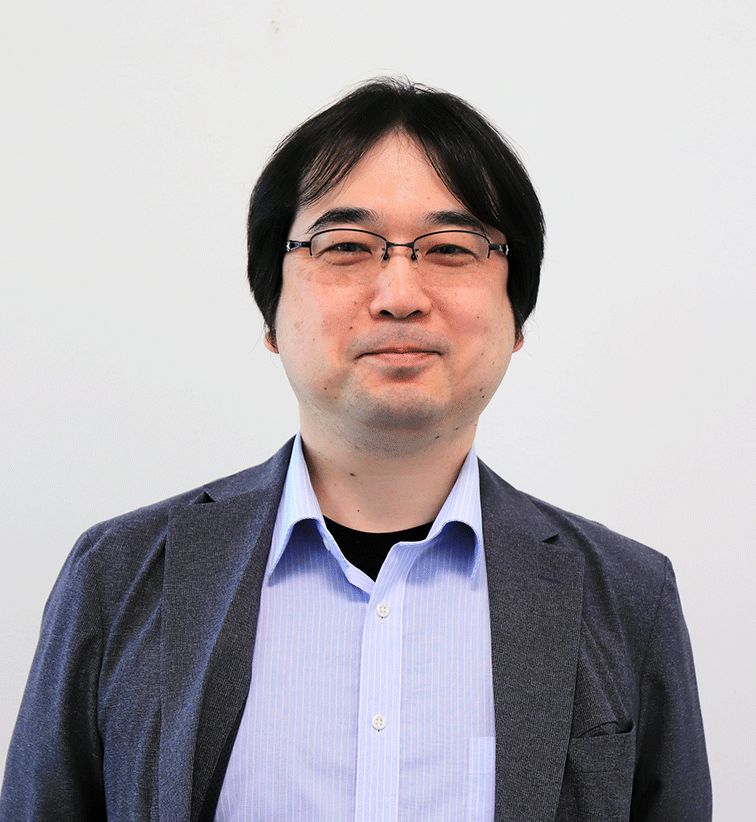
藤原 博典
Fujiwara Hironori
漢方薬学科/薬用資源学研究室
【教授】
SDGsへの取り組み




最終学歴
東北大学大学院 薬学研究科 博士後期課程修了
取得学位
博士(薬学) 東北大学
所属学会
日本薬学会、日本薬理学会
現在の専門分野
漢方薬理学、中枢薬理学
現在の研究課題
●モデル動物を用いた発達障害に有効性を示す漢方薬の探索および機序解明
●モデル動物を用いた認知症」に有効性を示す漢方薬の探索および機序解明
主要研究業績
●生薬由来アミロイド凝集抑制物質の開発
●漢方薬による認知症発症抑制の基礎的検討
●発達障害モデル動物の作成及びそれを用いた発症機構の解明
●モデル動物に表出する発達障害様症状に対する漢方薬の効果
最近の研究業績
1. STAM1-deficient mice exhibit an attention-deficit/hyperactivity disorder-like phenotype. Fujiwara H, Nakagawasai O, Suzuki S, Tajima H, Takahashi K, Onogi H, Sakuma W, Tan-No K, Murata K. Biochem Biophys Res Commun. 2026; 799:153264.
2. Kami-shoyo-san ameliorates sociability deficits in ovariectomized mice, a putative female model of autism spectrum disorder, via facilitating dopamine D1 and GABAA receptor functions. Guo Q, Ebihara K, Fujiwara H, Toume K, Awale S, Araki R, Yabe T, Dong E, Matsumoto K. J Ethnopharmacol. 201;236:231-239.
3. Kami-shoyo-san improves ASD-like behaviors caused by decreasing allopregnanolone biosynthesis in an SKF mouse model of autism. Guo QY, Ebihara K, Shimodaira T, Fujiwara H, Toume K, Dibwe DF, Awale S, Araki R, Yabe T, Matsumoto K. PLoS One. 2019;14:e0211266.
4. Orengedokuto and san'oshashinto improve memory deficits by inhibiting aging-dependent activation of glycogen synthase kinase-3β. Fujiwara H, Yoshida J, Dibwe DF, Awale S, Hoshino H, Kohama H, Arai H, Kudo Y, Matsumoto K. J Tradit Complement Med. 2018;9:328-335.
5. Endogenous acetylcholine regulates neuronal and astrocytic vascular endothelial growth factor expression levels via different acetylcholine receptor mechanisms. Kimura K, Matsumoto K, Ohtake H, Oka JI, Fujiwara H. Neurochem Int. 2018i118:42-51.
6. Sansoninto, a traditional herbal medicine, ameliorates behavioral abnormalities and down-regulation of early growth response-1 expression in mice exposed to social isolation stress. Fujiwara H, Tsushima R, Okada R, Awale S, Araki R, Yabe T, Matsumoto K. J Tradit Complement Med. 2017;8:81-88.
7. Decrease in endogenous brain allopregnanolone induces autism spectrum disorder (ASD)-like behavior in mice: A novel animal model of ASD. Ebihara K, Fujiwara H, Awale S, Dibwe DF, Araki R, Yabe T, Matsumoto K. Behav Brain Res. 2017;334:6-15.
8. Daily administration of yokukansan and keishito prevents social isolation-induced behavioral abnormalities and down-regulation of phosphorylation of neuroplasticity-related signaling molecules in mice. Fujiwara H, Han Y, Ebihara K, Awale S, Araki R, Yabe T, Matsumoto K. BMC Complement Altern Med. 2017 ;17:195.
9. Nobiletin, a flavone from Citrus depressa, induces gene expression and increases the protein level and activity of neprilysin in SK-N-SH cells. Fujiwara H, Kimura J, Sakamoto M, Yokosuka A, Mimaki Y, Murata K, Yamaguchi K, Ohizumi Y. Can J Physiol Pharmacol. 2014;92:351-355.
10. Yokukansan, a traditional Japanese medicine, ameliorates memory disturbance and abnormal social interaction with anti-aggregation effect of cerebral amyloid β proteins in amyloid precursor protein transgenic mice. Fujiwara H, Takayama S, Iwasaki K, Tabuchi M, Yamaguchi T, Sekiguchi K, Ikarashi Y, Kudo Y, Kase Y, Arai H, Yaegashi N. Neuroscience. 2011;180:305-313.
11. A traditional medicinal herb Paeonia suffruticosa and its active constituent 1,2,3,4,6-penta-O-galloyl-beta-D-glucopyranose have potent anti-aggregation effects on Alzheimer's amyloid beta proteins in vitro and in vivo. Fujiwara H, Tabuchi M, Yamaguchi T, Iwasaki K, Furukawa K, Sekiguchi K, Ikarashi Y, Kudo Y, Higuchi M, Saido TC, Maeda S, Takashima A, Hara M, Yaegashi N, Kase Y, Arai H. J Neurochem. 2009;109:1648-1657.
12. Uncaria rhynchophylla, a Chinese medicinal herb, has potent antiaggregation effects on Alzheimer's beta-amyloid proteins. Fujiwara H, Iwasaki K, Furukawa K, Seki T, He M, Maruyama M, Tomita N, Kudo Y, Higuchi M, Saido TC, Maeda S, Takashima A, Hara M, Ohizumi Y, Arai H. J Neurosci Res. 2006;84:427-33.